Within this series of posts on the antiquity philosophers, I’ve discussed Socrates’ Socratic method - which is a form of early dialectic reasoning, to understand understand the truth. I’ve discussed Plato’s Theory of Forms - which posits that the physical world we perceive is not real but rather based on a “higher, more perfect” world of Forms. Both of these philosophers are important to the development of Western philosophy, and went to great lengths to explore the nature of reality, with Socrates even dying for his beliefs. I want to finish this series by discussing some work from, who in my opinion, is the most important philosopher of the antiquity, Aristotle.
Recap
Plato’s Theory of Forms might be one of the first ideas that we can consider as a form of metaphysics - the study of the nature of reality. Please revist the previous post for a refresher on this idea as this post will be building on it. One thing I forgot to mention in the previous post is how Plato’s upbringing and experiences shaped his ideas, and I think its worth briefly discussing.
Following Socrates’ death, Plato left Athens and travelled around the Mediterranean, during which at some point he was part of the Pythagorean school, and yes, this is the same Pythagoras who is famous for the Pythagorean theorem. So Plato was influenced by mathematical/geometrical ideas, and you can see this in his Theory of Forms. For example, he believed there is a perfect Form of a circle, and in the real world you can find many instances of “circle-ness” but these are imperfect copies of the perfect Form of a circle. Similar to geometric concepts, Plato’s perfect Forms exist in an abstract realm, and the physical world is a reflection of these Forms.
Plato’s student, Aristotle, had a big issue with Plato’s Theory of Forms. He found it needlessly complex. Unlike Plato, Aristotle was influenced by nature and he was fascinated by the natural world. He believed the true essence of things can be found within themselves. And this is where we get Aristotle’s solution to Plato’s Theory of Forms - the Theory of Universals, or if you’re a pretentious modern-day Philosopher, you can also call it the hylomorphic theory of immanent realism.
The Theory of Universals
Occam’s razor states that when faced with competing explanations, the simplest explanation is usually the correct one. Let’s apply this to Plato’s and Aristotle’s theories of how properties exist in objects.
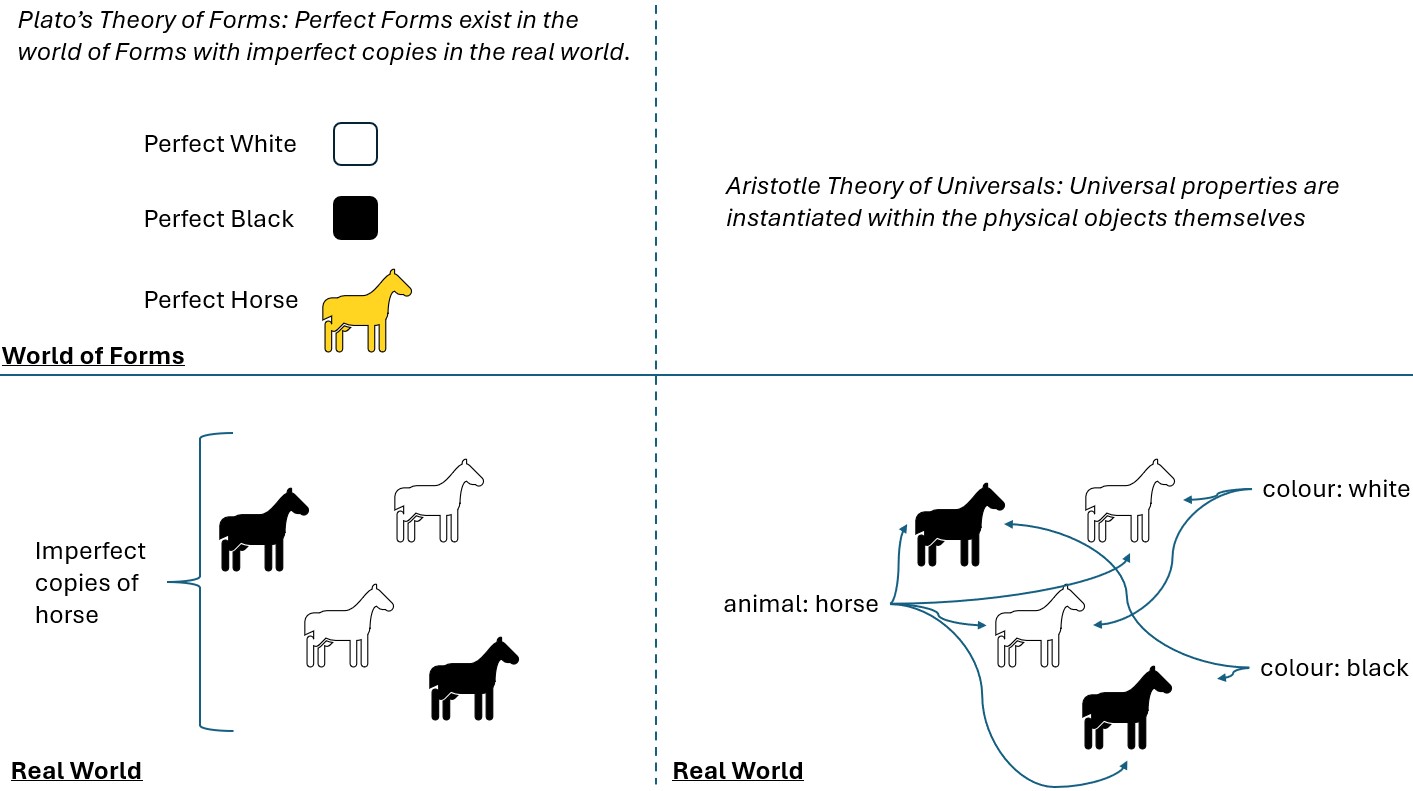
Aristotle’s Theory of Universals proposes that universal properties (essences) exist within physical objects themselves. It’s beautifully simple. Consider a herd of horses - some white, some black. Within this herd, each horse instantiates the universal property of being a horse (animal: horse). Each individual horse can also instantiate other properties, like its color (color: white). The beauty of Aristotle’s theory is that these universal properties can be instantiated multiple times in the same object, and they exist right here in the physical world.
In contrast, Plato’s Theory of Forms suggests that there is a perfect Form of a horse in a separate realm, and what we are seeing in the physical world are imperfect copies. Likewise for colour and other properties. Since Plato’s theory requires us to imagine a separate world, it is that more complicated compared to Aristotle’s.
Aristotle’s Theory of Universals is rooted to the physical world, and so it had incredibly important implications for science, that we still benefit from today. Take these examples we take for granted:
- Biological taxonomy groups organisms based on their shared properties - Aristotle was actually the first to do this. He classified animals based on shared properties.
- Laws of nature, for example gravity. Gravity affects all objects with mass because mass is a universal property - Aristotle actually attempted to explain this using his laws of motion, obviously not successfully, but he made a great start.
- Scientific method has roots in Aristotle’s Theory of Universals. Just as Aristotle believed we can understand universal principles by studying particular instances, the scientific method moves from specific observations to general principles through empirical study. For example, by observing that vaccinations prevented smallpox, scientists developed the general principle that vaccines can prevent diseases.
Criticisms and Counterarguments
I should have addressed this earlier, but let’s talk about the Problem of Universals. Look at the sky and the sea - they’re clearly different things, yet we can agree they share something in common: they’re both blue. This raises an interesting question: is “blue” something that exists beyond these objects? What exactly is the nature of this blueness we recognize in both?
Plato and Aristotle approached this question very differently. Plato would say that “blue” exists in a separate realm, independent of physical objects like the sky and sea. Aristotle, being more practical, would argue that blue only exists as a property within particular objects - it’s instantiated in the sky and sea, but doesn’t exist floating around somewhere on its own. This debate about how universal properties exist is the Problem of Universals.
Now, there’s an obvious issue here: none of this is falsifiable. We’re dealing with metaphysical questions that can’t be empirically tested, so in a strict scientific sense, we can never truly settle this debate. Moreover, we’re trying to understand nature using human-centric ideas. Nature doesn’t care about our concept of universals - it simply exists as it is. The problem is that we are insecure apes that hate uncertainty, so we frame everything in terms of what we can understand.
But does this make the Problem of Universals meaningless? Not at all. As we’ve seen, Aristotle’s approach to universals helped develop the scientific method, classification systems, and our understanding of laws of nature. While we can’t empirically prove these metaphysical theories, wrestling with them has advanced our understanding of both the world and ourselves.
Relevance to Modern Society
Usually in this section of my posts I’ll discuss the relevance of the philosopher’s idea to modern society but I’ve already done that above. Aristotle was immense. He shaped the thinking of the western world. What I want to discuss now is, why is philosophy even important? Especially these metaphysical questions on understanding the nature of reality.
I want you to imagine that you’re back in school, and you’re doing linear algebra. That one kid in class is annoyed and he’s complaining about why Pythagoras theorem is not important in the real world. He’s asking why he needs to learn this when he’s never going to use it in real life. And he’s right! Unless you’re one of the many brilliant people still using Pythagoras theorem in their everyday life, it isn’t that important. But what this kid fails not understand is that it’s not the knowledge of the theorem that’s important, its the learning of theorem that’s key.
By understanding Pythagoras’s theorem, you have developed an understanding of abstract thinking. You have developed an ability to logically reason through problems. You have developed critical thinking skills. Next time you’re faced with a problem, you will be able to think through it abstractly, logically and critically; even if you aren’t consciously aware of it because you have made the effort to understand the process when it was not immediately useful to you.
Philosophy is the same.
Racial and sexist biases in AI
I couldn’t help myself, I’m going to finish off with an example of why its important to understand Plato’s Theory of Forms and Aristotle’s Theory of Universals. Let’s consider the development of complex AI systems. We want our system to recognise humans.
From my understanding, currently the dominant approach in AI to recognise objects is similar to Plato’s Theory of Forms. We train AI systems with many examples of humans and hoping it will learn the ideal “Form” of humans. It’s not working. These systems are demonstrating racist and sexist biases reflected in societal prejudices in the training data.
We might be better off using an Aristotelian approach, where the system would focus on understanding the essential properties that make something “human” through direct observation and reasoning. This could potentially lead to more robust and ethical AI systems that recognise the fundamental qualities of all humans, regardless of superficial differences.
Otherwise we might have an I, Robot scenario on our hands.

 Philosophy Profiles #3: Aristotle