In my previous post, I discussed Aristotle’s Theory of Universals; which proposes that universal properties (essences) exist within physical objects themselves. I discussed what universals are, but not why they exist. To understand why universals exist, we need to examine how things come to be and what makes them what they are.
Aristotle’s Four Causes
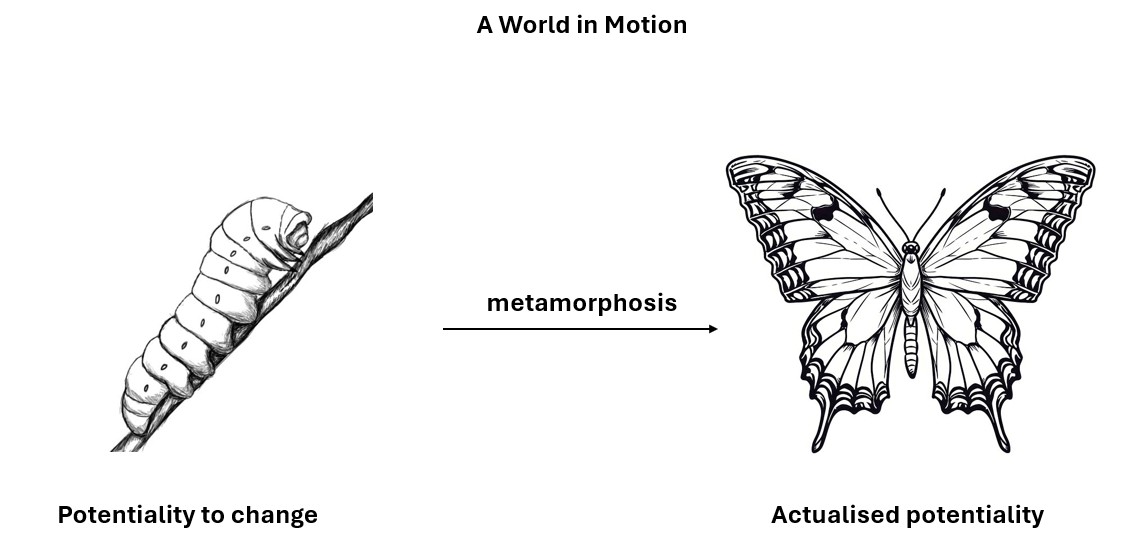
If you are a rational thinking being, you know that for something to exist it must have come from somewhere. Things don’t just pop into existence. Aristotle saw the physical world and observed that it is not immutable, but that it is subject to change. Things have potentiality - the ability to change, and eventually this change is actualised. Think of a caterpillar turning into a butterfly. The caterpillar has the potentiality to become a butterfly, and once it has metamorphosised it has actualised this potentiality to become a butterfly.
Through these observations, Aristotle proposed that everything that exists has a cause. Well more specifically, Four Causes, and he used this framework to explain the essence of things. To note, cause in the context of Aristotle is not the same as the way we use the word today, a closer translation would be “explanation”.
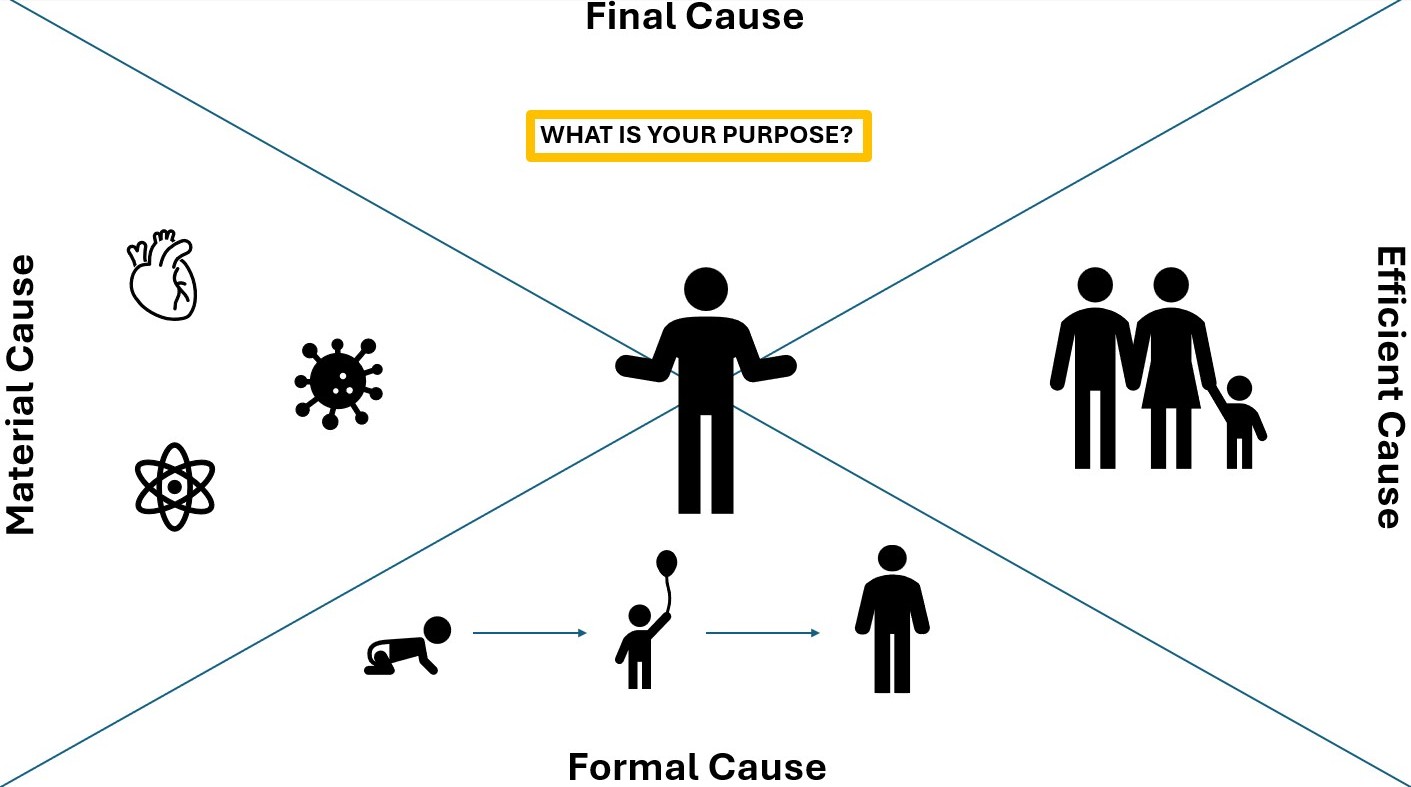
These Four Causes comprise the essence of something, it is that which makes something uniquely itself. These Four Causes are:
- The material cause - the matter that makes up the object.
- The formal cause - the form or shape of the object.
- The efficient cause - the agent that brings about the change.
- The final cause - the purpose or goal of the object.
I’m going to use a somewhat ambitious example to illustrate these Four Causes. This example is: You.
The material cause
Super simple. You are a human being (I hope), and you are made up of cells. These cells form tissues, which form organs, which form systems, which form something that resembles you. We can even go smaller than cells, and say you are made up of atoms. Basically, you are made up of physical matter and maybe even spiritual matter, depending on your beliefs.
The formal cause
Your physical matter has a form, and to be you, this matter is organised in a unique and special manner. An interesting thought experiment is to think about how much of you is actually you. Because you, my friend, are mutable. Is the you of today the same as you of 10 years ago?
The efficient cause
The reason you exist is because of your parents - or more specifically, your parents’ sperm and egg. They are the efficient cause of your existence. If you came into existence some other way, please let me know - I’d love to hear it.
The final cause
The final cause is the purpose or goal of your existence. Aristotle used the word “telos” to describe this, and teleology is a branch of philosophy that gives an explanation for the existence of things. If you’re reading this, I’d like to assume that you are a curious and clever person who is looking to understand the world around you. In addition to all the other reasons why you are here in this world.
Criticisms and Counterarguments
Aristotle’s Four Causes enable us to understand the essence of things and the world around us. The world is always changing, and by thinking about the Four Causes, it allows us to better understand why things are the way they are. I’ll briefly break down the criticisms and counterarguments to the Four Causes.
- The material cause:
- Hopefully it’s quite obvious from my explation above, but how does one define material? This cause suffers from reductionism. Like the example of you above, how can we even begin to define the material that makes up you?
- The formal cause:
- Makes sense when we consider the material cause - as I said above, most living things are made out of the same matter but its the arrangement of that matter that makes something unique. That said, how does one define the arrangement of the material? This is an ontological problem.
- The efficient cause:
- Suffers from infinite regress issues. If we are to understand the efficient cause, we must understand the efficient cause of the efficient cause. If your parents made you, who made your parents? Who made their parents? And so on.
- The final cause:
- Firstly, the final cause has to be defined by humans - we are the ones who give meaning to the world around us.
- Secondly, does something need a purpose or goal to exist? Let’s look at biological evolution: species that exist today won a genetic lottery - they adapted to their environment due to random mutations and natural selection. No purpose or goal was required for them to exist.
- Aristotle actually had a solution to criticisms of the final cause - the unmoved mover, the primary cause of all the motion in the universe. It is one that moves all things but not itself, and so escapes the infinite regress problem.
Aristotle’s Four Causes are relatively simple to understand, but why is it important to understand this framework?
Relevance to Modern Society
This section is controversial, so please consider this as a disclaimer.
I’m going to do something a little adventurous and maybe controversial here. I’m going to apply Aristotle’s Four Causes as a framework to understand the misrepresentation of intelligence that was driven by the eugenics movement in the late 19th and early 20th century, and unfortunately still existing today. Eugenicists argued that certain human traits, such as intelligence, were heritable, and they used IQ testing to identify those who were “feeble-minded” to be discouraged from reproducing.
The phenomena we are going to break down is that “human intelligence is heritable”.
- The material cause: Intelligence is a trait that is heritable, so it must have a genetic component.
- Misrepresentation: This is incredibly reductionist. Intelligence is not a single trait, and it is wildly inappropriate to ignore the complex interactions of genetics, environment, education, and individual agency.
- The formal cause: Intelligence was measured using IQ tests.
- Misrepresentation: IQ tests are flawed, they are culturally biased and do not accurately measure intelligence. Here, eugenicists failed to acknowledge that intelligence is a dynamic, multi-faceted, and culturally constructed concept.
- The efficient cause: Certain groups of people were identified as being less intelligent, and so there must exist a group of intelligent people that drive intelligence in the population.
- Misrepresentation: It is wrong to believe that we can “engineer” human intelligence through selective breeding.
- The final cause: The purpose of eugenics is to improve the human race.
- Misrepresentation: By not allowing certain people to reproduce, are you not suppressing their potentiality to contribute to society? Who are you to decide their impact on society? Eugenics is a form of social engineering, and it is wrong to believe that humans can be engineered.
Anyways, this was a heavy topic to end on, difficult to write, but I hope you found it insightful. Aristotle’s Four Causes are a powerful framework that can help us better understand essences of things. And by thinking of things in such a logical manner, we can actually be more critical of our own beliefs and assumptions.
The framework’s enduring relevance lies not just in its historical significance, but in its practical application to modern challenges. Whether we’re examining scientific theories, technological innovations, or sociatal issues, the Four Causes allows us to consider the complete picture: what something is made of, how it’s structured, what brought it about, and what purpose it serves. This comprehensive approach to understanding can help us avoid reductionist thinking and make more informed, ethical decisions about the world we’re living in.
 Philosophy #3: Why does any of this even matter?