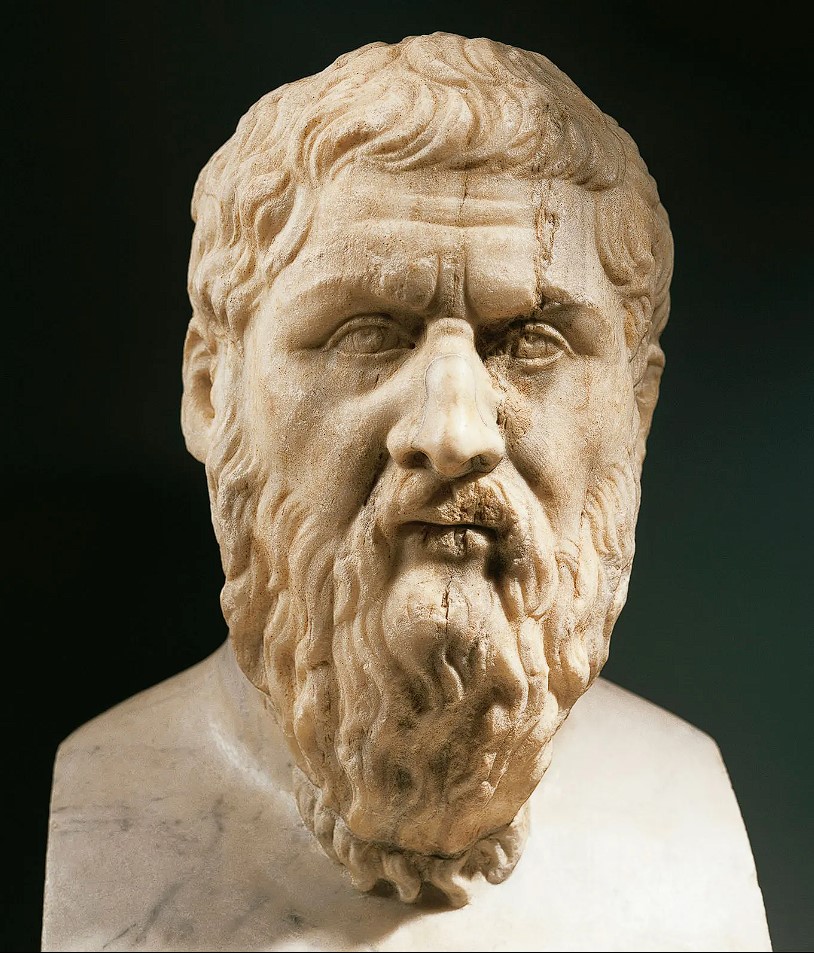
Aristocles (Plato) (428?-347? BC)
Historical Context
Era
Ancient Greece - The Classical Period
Location
Athens, Greece
Major Historical Events
- The Peloponnesian War - ending with the defeat of Athens (431-404BC)
- The Golden Age of Athens - Pericles’ rule (461-429BC)
- The trial and death of Socrates (399BC)
- Plato founded the Academy (387BC)
Social/Political Climate
It was a prosporous time in Athens, a state known for its democracy, culture, and economic growth. However during the time Plato was alive, Athens was undergoing great change and unrest. The Peloponnesian War had ended with the defeat of Athens, and the rise of tyrants in the city. Although Athens was still a major power in the region, it faced a period of instability and turmoil - mainly at the hands of the Spartans, and later the Macedonians.
Personal Background
Early Life
Plato was born towards the end of the Golden Age of Athens, and at the beginning of Peloponnesian War. He was born to into an aristocratic and influential family. He was educated in philosophy, poetry, and gymnastics.
At a young age, Plato became a devote follower of Socrates, and actually was one of the youth’s that Socrates was accused of corrupting. Following Socrates’ death, Plato left Athens and did a bit of soul-searching around southern Italy, Sicily, and Egypt. He spent some time with the followers of Pythagoras.
Plato eventually returned to Athens (387 BC) and founded the Academy, one of the first known higher education institutions in the western world. It was here that he educated some of his most famous students, including Aristotle.
Key Influences
Career/Life Path
Plato established the Academy, so I guess he’s one of the first known professors.
Core Philosophical Contributions
Main Areas of Focus
- Epistemology
- Metaphysics
- Politics
Key Concepts
- Theory of Forms - a theory suggesting that the physical world, the world we perceive through our senses, is not as real or true as the absolute and perfect world of Forms/Ideas.
- Theory of innate knowledge - a theory that suggests knowledge is innate and that the process of learning is developing ideas that are already within us. This knowledge is infalliable and exists in the world of Forms, whereas opinions exist in the physical world.
- Form of the Good - unlike the theory of Forms, the Form of the Good is the highest Form and the source of all other Forms. It is the origin of knowledge, although not knowledge itself, and things that are just and true gain their usefulness and value from it.
Major Works
- Plato wrote many dialogues - these are conversations typically between Socrates and other characters. Among some of his most famous dialogues are:
Historical Impact
Legacy
- Plato might be one of the most influential philosophers of all time, particularly for Western philosophy. His ideas have been studied and debated for centuries, and continue to be studied today.
- Plato’s philosophy influenced many modern religions like Christianity, Judaism, and Islam.
- Foundation of The Academy - one of the first known higher education institutions in the western world. It existed for over 900 years!
- The list is long, and maybe this quote from Alfred North Whitehead best sums up Plato’s legacy: “The safest general characterization of the European philosophical tradition is that it consists of a series of footnotes to Plato.”
Modern Relevance
- Metaphysics - our understanding of the world and reality i.e nature of consciousness, existence of the soul, and the nature of reality
- Epistemology - our understanding of knowledge and how we know things i.e the nature of knowledge, the sources of knowledge, and the extent of human knowledge
- Ethics - our understanding of right and wrong, and how we should live our lives
Death and Final Years
Plato never retired. He continued to teach and write until his death. A true lover of knowledge. Before his death, he appointed his nephew, Speusippus, to take over the running of the Academy.
In his final days, Plato, battling a fever and on the brink of death, listened to music played on a flute by a Thracian slave girl. He apparently even had enough lucidity to critique the musician’s lack of rhythm.
It is said that Plato died peacefully in his sleep. He was buried in a garden at The Academy.
Related Philosophers
- Aristotle (Student)
- St. Augustine (Influence)
- Immanuel Kant (Influence)
- Alfred North Whitehead (Influence)
Last Updated: 30.10.24
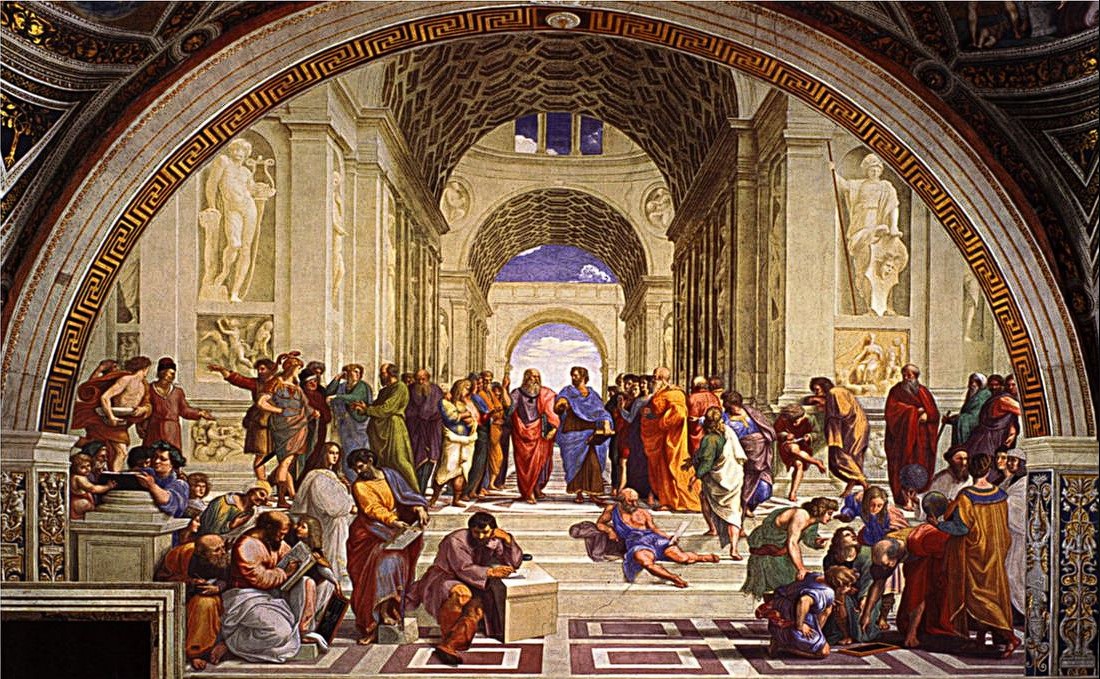 Philosophy #1: Socrates on Intellectual Humility