
So far, I’ve written about how fluid systems in the body and blood-borne proteins can help us understand how the body functions and what happens when things go wrong - particularly in ageing disorders. However, I have not written about the function of any specific proteins, I’ve kept things somewhat holistic. So now I want to discuss a specific protein, and how this protein is supposedly a key modulator of healthspan and lifespan in mammals.
An objective summary of the paper
Cell signalling
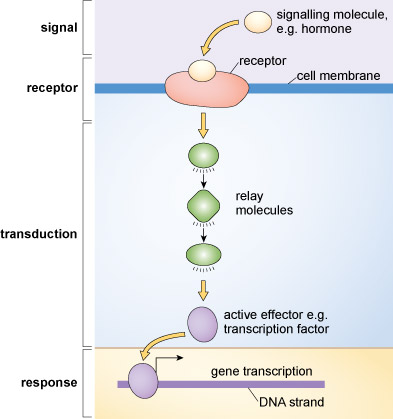
For the unitiated, I want to briefly talk about the fun topic that is cell signalling. Cell signalling, in a nutshell, is the process by which cells communicate with each other, the environment, and themselves. It’s fundamental to all aspects of life, and its the difference between a cell that grows and a cell that dies. Typically, as you see in high school textbooks, cells would communicate with each using a variety of molecules - we can call these “messenger molecules”. These messengers can interact with receptors on cell surfaces, which then transduces a cascade of intracellular pathways that eventually leads to a cell response (Figure 1).
The above example is an incredibly superficial overview of cell signalling. In reality, the story is much more complicated. There are many different types of cell signalling pathways and many different types of receptors. Take for example, one of the most important signalling pathways, the AMPK/mTORC1 pathway - which is a key cell signalling pathway regulating cell growth, metabolism, and survival (Figure 2).
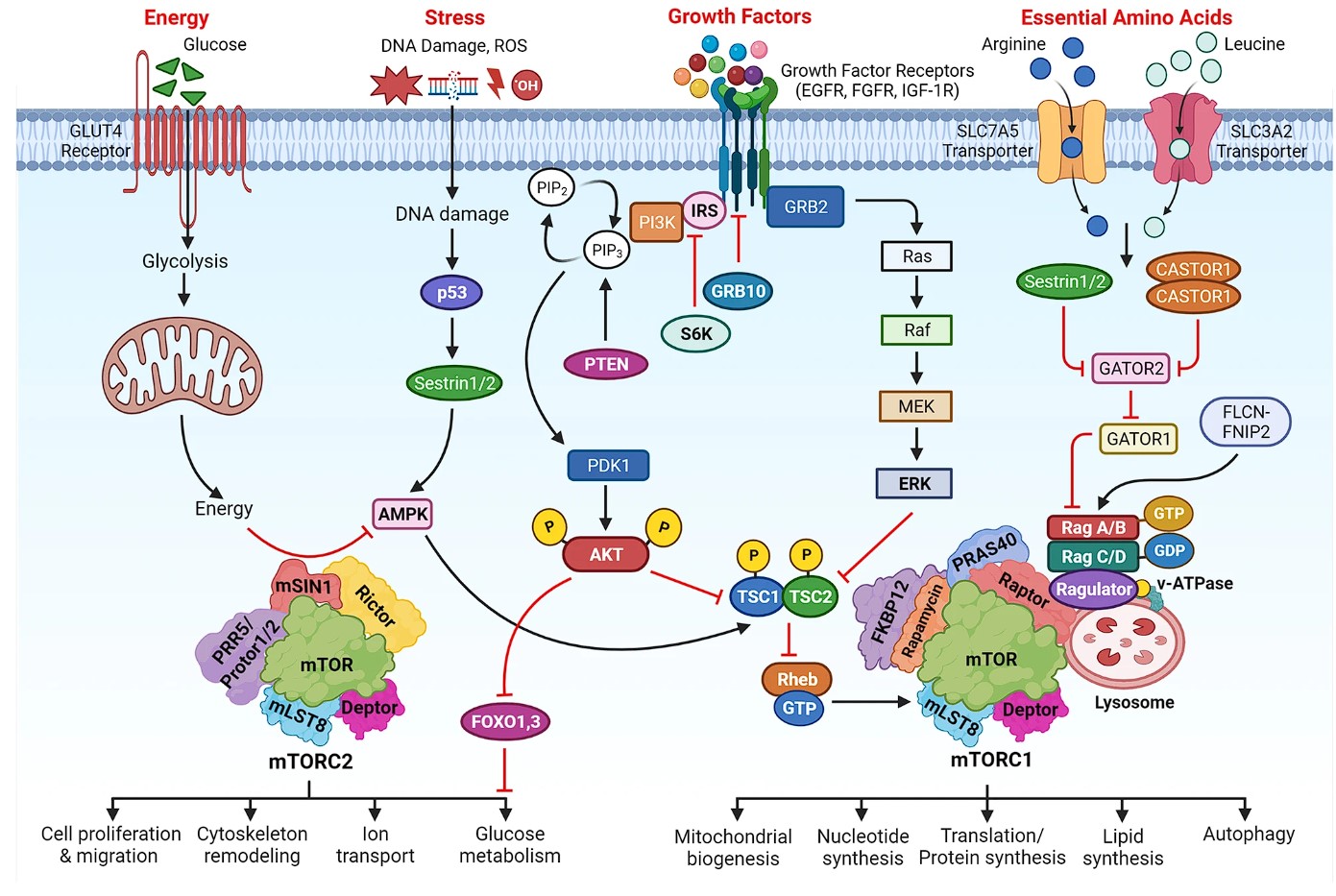
AMPK (AMP-activated protein kinase) and mTORC1 (mammalian target of rapamycin complex 1) complement each other by playing opposing roles in responding to a cell’s energy status. AMPK, the energy sensor, is activated when cellular energy levels are low, resulting in increased glucose uptake, fatty acid oxidation, and inhibition of protein synthesis. This helps restore cellular energy levels and during which mTORC1 signalling is inhibited. In contrast, mTORC1, the growth promoter, is activated when cellular levels are high and so it responds by reducing glucose uptake, and increasing lipid and protein synthesis, ultimately promoting cell growth. mTORC1 activation makes use of the abundant cellular energy to grow and proliferate, and during which AMPK signalling is inhibited. It’s a ying-yang relationship.
The AMPK/mTORC1 pathway plays an important and complex role in cancer. Generally, in healthy individuals, AMPK suppresses tumours by inhibiting cell proliferation and inducing cell cycle arrest. In individuals with cancer, AMPK can promote cancer growth and survival, particularly in energy-deprived conditions - remember in these conditions AMPK is aiming to restore energy levels. mTORC1, on the other hand, is hyperactivated in cancer leading to tumor cell growth - particularly in energy-rich conditions. To summarise, in individuals with cancer, a situation arises where AMPK can promote survival of cancerous cells whilst mTORC1 promotes tumour cell proliferation. The role of AMPK/mTORC1 in cancer is contradictory and complex, so do not worry if this is confusing, what is important to understand is that targeting this pathway is a promising area in cancer therapeutics.
That said, I’m going to discuss the specific protein I mentioned earlier, Interleukin-11 (IL-11) - a “novel longevity factor”, which Widjaja et al., (2024) targeted to enhance healthspan and lifespan.
IL-11
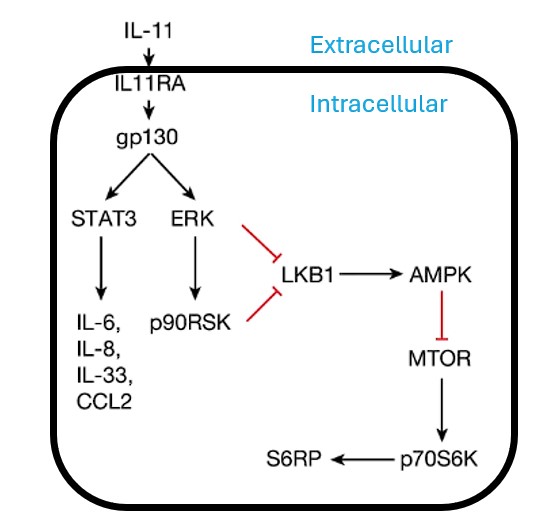
IL-11, a pleotropic cytokine (meaning it has many diverse functions), is typically secreted by cells during a proinflammatory response. Among it’s many functions, it has been shown to promote tumour growth and metastasis. It does this by inhibiting AMPK, which in turn activates mTORC1 (Figure 3). As mentioned previously, hyperactivation of mTORC1 promotes tumour cell proliferation.
And this is where Widjaja et al.’s story begins. They hypothesised that IL-11 signalling has a negative effect on healthspan and lifespan in mice, so by inhibiting IL-11 signalling, they can test whether this extends healthspan and lifespan.
Study results
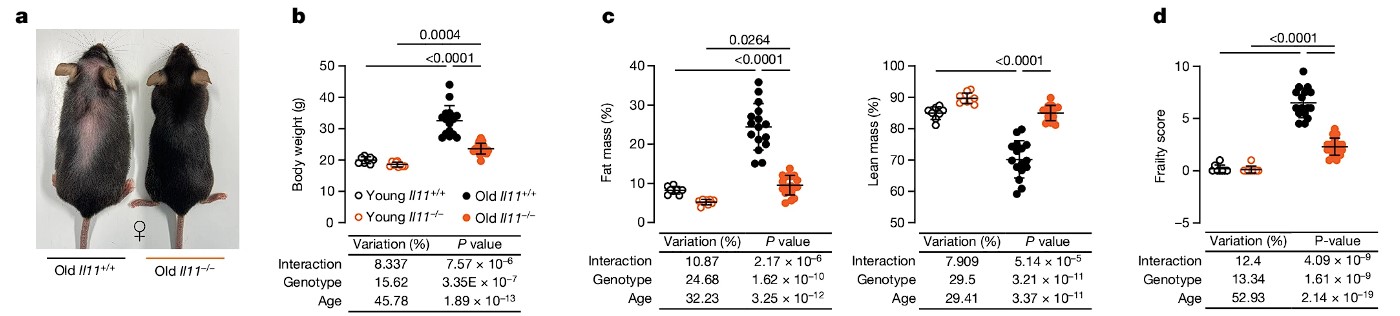
Firstly, they showed that IL-11 levels are indeed increased in ageing mice. They then genetically knocked out (removed) Il-11 in mice, so these mice can never produce IL-11 and found that old mice now look young (Figure 4a)?! Not only that, but their body weight, food intake, lean muscle mass, serum cholestrol and triglyceride levels, glucose tolerance, and general frailty was similar to substantially younger mice (Figure 4b-d). Young mice were 3 months old, and the old mice were ~26 months old. WOW.
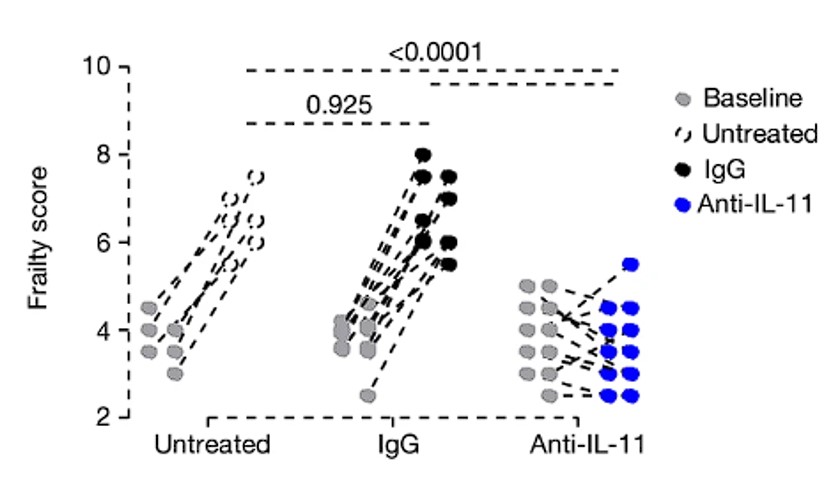
It’s one thing to demonstrate that genetically ablating Il-11 extends healthspan in mice, but to show that therapuetically targeting IL-11 yields similar results is even more convicing. So, the authors administered a neutralising IL-11 (anti-IL-11) antibody to mice ~19 months old, and found pratically the same results as genetically ablating IL-11 (Figure 5). Incredible.
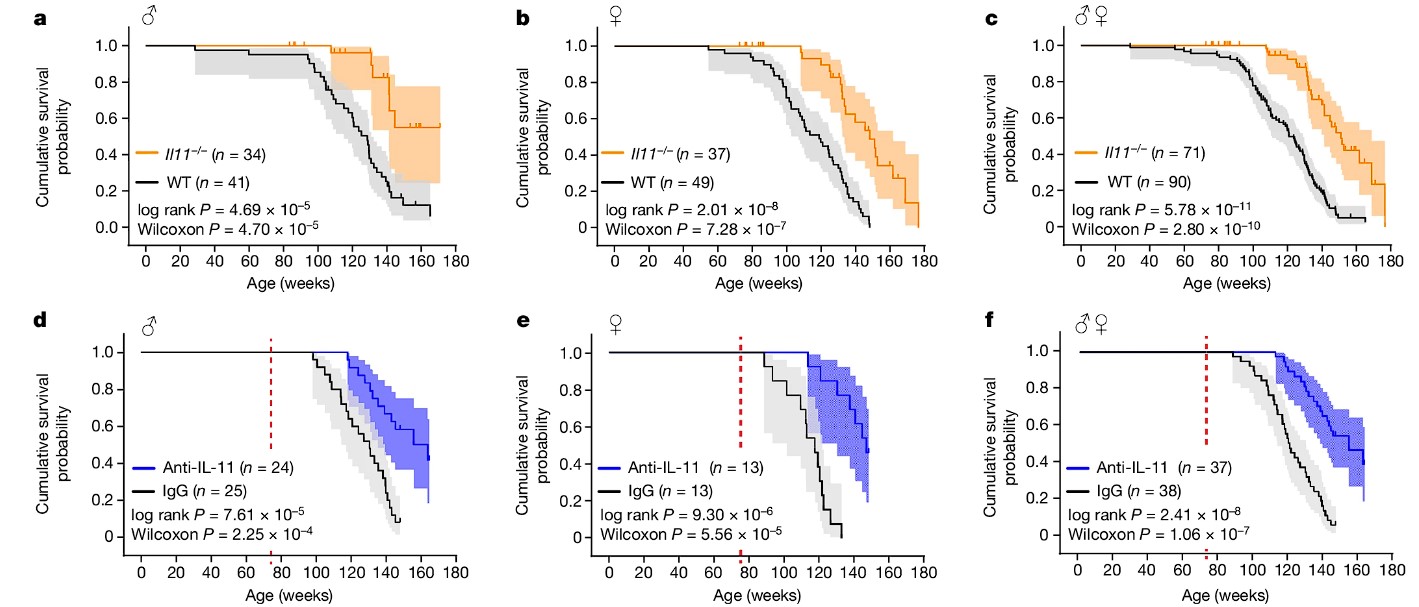
Lastly, they showed that improvements in healthspan is translated to improvements in lifespan. Ablation of IL-11 using both genetics (Figure 6a-c) and antibodies (Figure 6d-f) prolonged the lifespan of mice by ~25%. It’s worth noting that longevity factors typically improve lifespan by ~15%, so an improvement of 25% is extraordinary.
Conclusions
Widjaja et al., showed that IL-11 is an important modulator of ageing, particularly through its effects on the metabolome. IL-11 is a promising candidate for therapeutic intervention to ageing.
My thoughts
Firstly, it was a little surprising to me that IL-11, as an anti-ageing factor, was not previously investigated like this. I should say that I am not an ageing scientist nor an immunologist, but I am learning. This is why I’m writing :) After doing some reading, I can see why it’s questionable to call IL-11 an anti-ageing factor.
So there’s a reason why I focused so much on the role of the AMPK/mTORC1 pathway in cancer. Widjaja et al. completed their results section by commenting that “cancers are a common cause of death in old mice and gross autopsy data revealed “fewer macroscopic tumours in mice with Il11 deletion… or on anti-IL-11 therapy”. Which then makes me wonder whether the anti-ageing effects they observed may have been anti-cancer effects. What I think might be happening is that old mice are more likely to develop cancers, and so by inhibiting IL-11 you are then activating AMPK which reduces the hyperactivation of mTOR and thus the likelihood of developing cancers. Easy to understand in the IL-11 knockout mice, but less so in the anti-IL-11 antibody treated mice, as cancers could have developed by 19 months age. A couple of experiments to test this:
- Administer anti-IL-11 antibodies to old mice with pre-existing cancers. Would this extend their healthspan and lifespan?
- Replicate these results in an accelerated ageing model. Rather than looking at mice that die because of cancer, look at mice that die early due to other ageing-related disease, such as Alzheimer’s disease.
These simple experiments would tell us whether the anti-ageing effects observed were due to cancer prevention, or other ageing-related mechanisms.
Secondly, where is the cognitive testing in these mice? This is my neuroscience bias talking, but one of the key factors in ageing is cognitive decline - which will be incredibly costly as the population continues to age. It would be interesting to see if targeting IL-11 can improve cognitive outcomes in older mice. My gut feeling says yes, given all the improvements in the metabolome.
Lastly, IL-11 is an incredibly important factor in the immune system. Lab mice live a pampered infection-free lifestyle, in organisms like us, depleting IL-11 might not be such a bright idea. Particularly in the event of a immune system attack, it may leave us susceptible to more damage than we would have wanted.
How does this work help society?
Widjaja et al. demonstrated an anti-IL-11 therapy could work, theoretically. That said, Boehringer Ingelheim announced in September 2023 clinical development of a IL-11 inhibitor antibody, BI 765423 with a Phase 1 study (NCT05658107) for the treatment of fibrotic diseases.
Like what Widjaja et al. (2024) did, repurposing these products for different disorders might be a market opportunity, given the role IL-11 plays in canonical biological pathways like AMPK/mTORC1.
 Science #2: Restoration of cervical lymphatic vessel function in aging rescues cerebrospinal fluid drainage