Unofficial title: “Making neurons dance to a certain beat, makes the brain clean itself”. It’s also a pretty good summary of the paper.
The image on the front page of the post is of the dancing neurons from 3rd prize winner of the DNRF Photo Competiton (2023).
An objective summary of the paper
Murdock et al., (2024) found that by entraining neurons to a certain frequency, in this case to gamma frequency, they could promote glymphatic clearance, and thus clear pathogenic proteins such as amyloid-beta from the brain.
A lot happened in this paper, and some very complex neuroscience without much known mechanisms, so I’ll break it down simply and hopefully at the end it makes sense.
The Glymphatic System
Firstly, the glymphatic system. I’ve already discussed this in Science #2, so I won’t go into too much detail here. The glymphatic system is the brain’s waste clearance system, it has other systems, but this is the one that is most relevant to this paper. Glymphatic clearance is the process of moving cerebrospinal fluid (CSF) through the brain via bulk flow, collecting waste products and clearing them out of the brain.
What I didn’t mention in Science #2 was how it is activated. As far as we are aware, the glymphatic system is activated by sleep, exercise, and pharmacological sedatives such as ketamine/xylazine, and medetomodine. What is interesting about sleep, exercise, and these pharmacological agents is that they activate brain networks that are typically not activated during wakeful rest. Before going any further, let’s quickly review brain networks.
Brain networks
“Neurons that fire together, wire together” - this is famous quote from Donald Hebb, to describe a phenomenon were neurons that are activated together by the same stimulus will likely fire (be activated) together. This is somewhat the basis of brain networks. Neurons in the brain respond to stimuli by engaging in electrical and chemical signalling. Neuroscientists found that by recording the electrical activity of neurons in the brain, using encephalography (EEG), they could identify patterns of activity that were associated with specific behaviours and brain states. These patterns of activity are known as networks or oscillations.
Take for example sleep, which has been highly characterised. We undergo several stages of sleep, and each stage is characterised by different patterns of neural activity, which is associated with a different sleep stage (Figure 1).
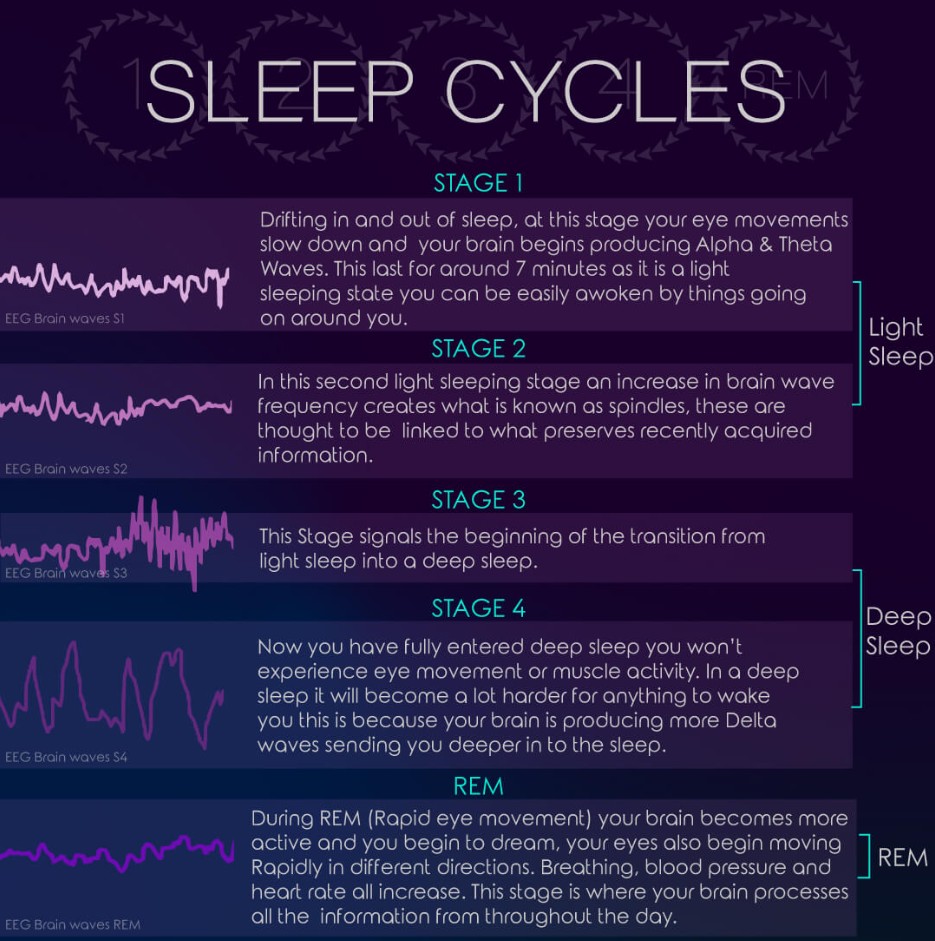
What’s pertinent to our discussion is that during stage 3 sleep, or NREM stage 3, researchers found this stage of sleep is characterised by slow and large delta waves/frequencies - its also called slow wave sleep, and periodically there are bursts of high gamma activity. Interestingly, this stage of sleep is associated with activation of the glymphatic system which, if you remember, clears the brain of waste products.
Entrainment of gamma oscillations
A while ago, Murdock et al., (2024) found that you can entrain neurons to a certain frequency, and this is not a new concept, but what they found when looking in the brain was incredibly interesting and novel. They found that you if you give animals a certain frequency of light, in this case gamma, you can make neurons in the brain fire at gamma frequency. If you do this to animals that express high levels of amyloid-beta, which is a protein that accumulates in the Alzhiemer’s disease brain, and is thought to be the primary cause of the disease - you can actually reduce the levels of amyloid-beta in the brain and improve the outcome of the disease, at least in mice.
Let me repeat that, if you flash light at a gamma frequency, you can rescue the brain from Alzhiemer’s disease related pathology. Crazy!
Equally, if you do the same with sound, you can make neurons in the brain fire at gamma frequency, and just like with light - you can reduce the levels of amyloid-beta in the brain and improve the outcome of the disease. Turns out you can both at the same time - hence the term “multisensory gamma stimulation” part of the title.
Rationale
So to bring it altogether: the authors had a method to entrain neurons to a gamma frequency, they found by doing this they can reduce amyloid burden and improve the outcome of the disease in mouse models. However, they were not entirely sure how this worked, but they hypothesised that the gamma oscillations would activate the glymphatic system, and thus clear the brain of waste products, since gamma oscillations are found in a stage of sleep that is associated with activation of the glymphatic system.
Disclaimer: I’m hesistant to go through all the details of the paper for two reasons:
- This is an incredibly complex paper, requiring a lot of background knowledge to understand. Even for people working in the field, it’s not easy to follow. So this will be a superficial summary, but encompassing the main points.
- A lot of the data is somewhat technical and redunant to the lay reader. Again, unless you’re working in the field, you would not need to know the details.
Results
Gamma stimulation clears brain amyloid
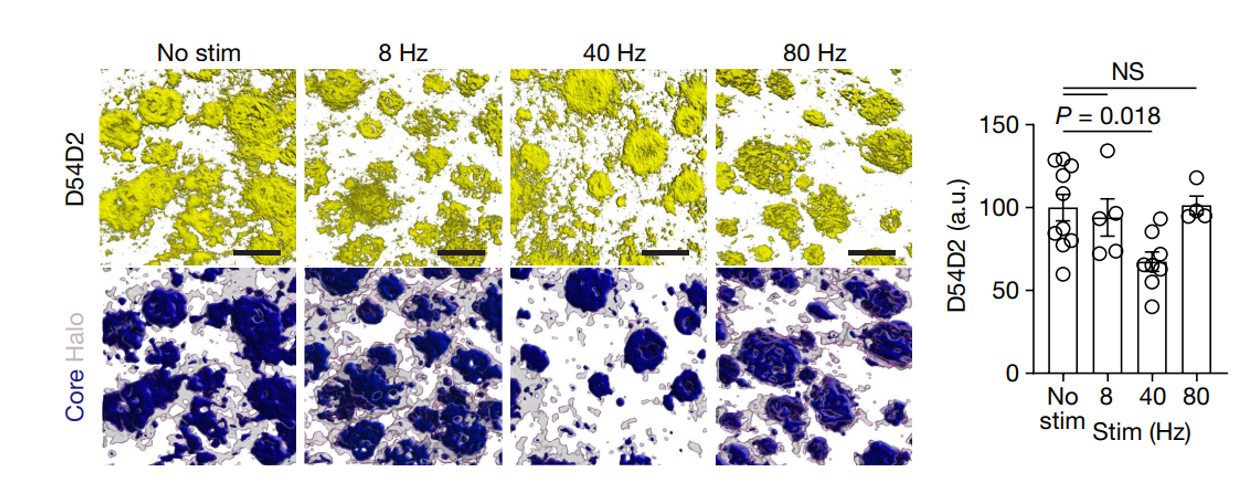
Using a mouse model of Alzhiemer’s disease, called 5XFAD - a very unfortunate mouse with 5 different mutations that cause Alzhiemer’s disease - the authors found that if they entrained neurons to a gamma frequency (40 Hz), they could reduce the levels of amyloid-beta in the brain (Figure 2). Importantly, if you entrain at a different frequency (8 or 80 Hz), you could not reduce the levels of amyloid-beta in the brain. Suggesting the importance of the gamma frequency in clearing the brain of amyloid-beta.
Gamma stimulation activates glymphatic system
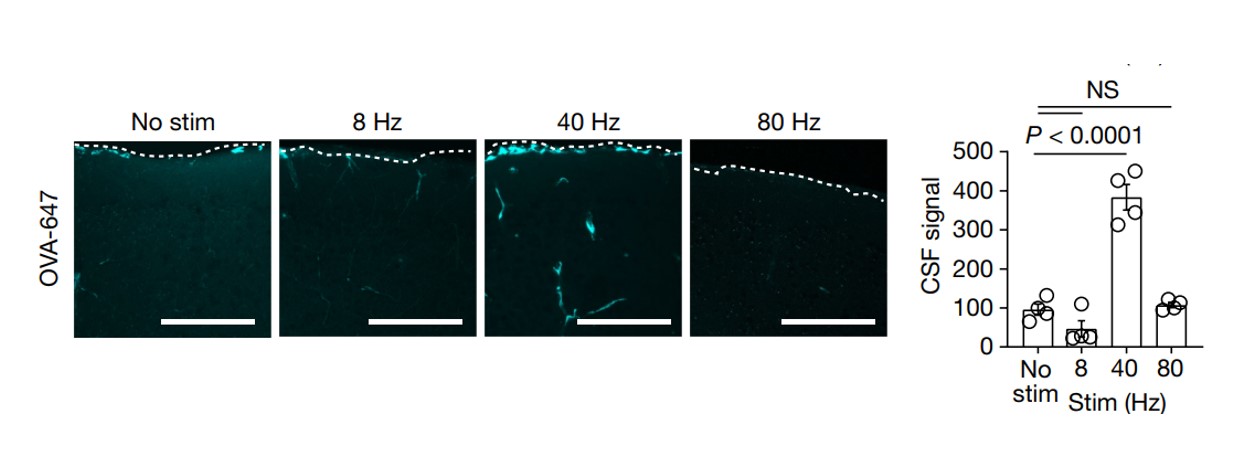
In the same mouse model, the authors found that if they entrained neurons to a gamma frequency (40 Hz), they could activate the glymphatic system (Figure 3). Again, if you entrain at a different frequency (8 or 80 Hz), you could not activate the glymphatic system.
By inhibiting the glymphatic system, you block the effects of gamma stimulation
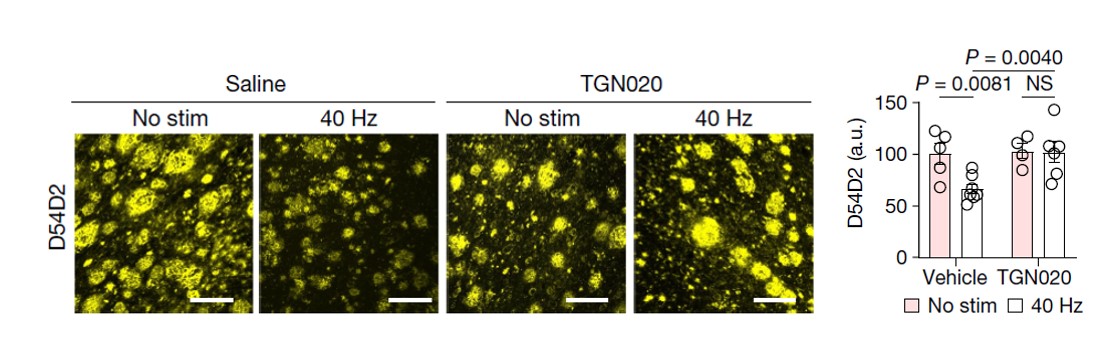
For this experiment, the authors used an inhibitor of glymphatic system called TGN-020 - more specifically its an AQP4 inhibitor. AQP4 is a water channel in the brain, that is needed for the movement of CSF and so for glymphatic clearance. If you block AQP4, you block the glymphatic system. The authors found that if they blocked the glymphatic system, they could not reduce the levels of amyloid-beta in the brain, even if they entrained neurons to a gamma frequency (Figure 4). This suggests that the glymphatic system is required for the effects of gamma stimulation.
Summary
In summary, the authors found that gamma stimulation can reduce the levels of amyloid-beta in the brain, and activate the glymphatic system. They also found that by blocking the glymphatic system, you block the effects of gamma stimulation. Importantly, multisensory gamma stimulation is a non-invasive way to reduce amyloid-beta in the brain, and could be a potential treatment for Alzhiemer’s disease.
My thoughts
This is an incredibly cool and exciting concept. By simply exposing individuals to a certain frequency of light and sound, you could potentially treat devastating neurodegenerative diseases like Alzhiemer’s disease. Great! My biggest worry is that this was initally reported in 2016, and since I haven’t heard much in terms of clinical trials - but this is not my field of interest. Reading around it seems that 16 clinical studies have been published, with “uneven but encouraging results” but none so far have reported reductions in amyloid-beta or tau in the brain. Unlike what we see in mouse models - which raises the question, again, of the relevance of mouse models to human disease.
The other thing that concerns me is the mechanism of entrainment. Why do neurons respond to a certain frequency by mimicing that frequency? It’s not clear why this phenomenon occurs, but I think it might be something similar to mirror neurons. A mirror neuron is a neuron that fires both when an animal acts and when the same animal observes the same action performed by another. Why mirror neurons exist is not really known. But it is interesting that they can mimic the action performed by an individual and the same action observed by another - as if they are entrained to that behaviour/action. Why is this relevant to gamma entrainment? Well, I think some neurons might have mimicry properties, and mirror the responses of our external environment internally. The reason could be as simple as building an internal representation of the environment in the brain.
In the case of gamma entrainment if, internally, neurons firing at gamma frequency activate the glymphatic system, and we can entrain neurons to gamma frequency externa`lly, forceably making them mimic that frequency, then we can activate the glymphatic system. What other frequencies associated with brain states could we forceably entrain? Hypothetically, what if there is a frequency associated with dopamine/serotonin release, and we can entrain neurons to that frequency, could we use it as a treatment for depression?
How does this work benefit society?
The last authors of this article, Prof. Edward Boyden and Prof. Li-Huei Tsai, have gone on to found a company called Cognito Therapeutics - a company that is developing a device that can entrain the brain to a certain frequency. They are running several clinical trials targeting Alzheimer’s disease, Parkinson’s disease, and Multiple Sclerosis (Figure 5). Their phase 2 Alzheimer’s disease clinical trial has good endpoints, with preservation of cognition, function, and brain volume. But similarly, to the current best treatment for Alzheimer’s disease, it is only slowing down rate of decline, not stopping it or reversing it - though with the current state of the field, this is nonetheless a great and exciting result, given that it’s completely non-invasive.

Altogether this is an incredibly exciting area of research, and I think we will see a lot of progress in the next few years. In the meantime, take a look at what 40Hz multisensory gamma stimulation feels like.
 Philosophy #4: Aristotle's Four Causes to Understanding Anything.